Showing posts with label 2000s. Show all posts

Monday, 30 December 2013

British web animation


 For a while, I was planning to write a short article on online animators from the UK - namely Jonti "Weebl" Picking, David Firth, Cyriak and Joel Veitch. I never got round to it, however, and now Nathan Wilkes of Skwigly has pipped me to the post.

Nathan's article focuses on Weebl, Firth, Cyriak, Tom Ridgewell, Ben "Wonchop" Smallman, Jamie "RageNineteen" Spicer-Lewis, Harry Partridge, Lee Hardcastle, Simon Tofield and Element Animation, along with Birdbox Studio, the Brothers McLeod and White Robot. It's a good selection, one that gives an idea of the variety of work out there on the 'net.

As an aside, perhaps it's just me, but "British web animation" seems like almost like a self-contradiction. A large amount commercial animation is made internationally these days, of course, but with animation made for the Internet, even the audience will be international.

As far as English-language work goes, just how relevant is nationality when discussing web animation...?

Friday, 29 November 2013

Adverts 1999/2000: Natwest and milk


A couple of adverts from the turn of the century...

The first is this rotoscoped 1999 Natwest ad, set to the theme from The Littlest Hobo.


Next is this 2000 advert for the National Dairy Council. It was one of (I believe) three adverts made as part of a campaign that used celebrities as characters; in this case, boxers Prince Naseem and Chris Eubank were lampooned.


Sunday, 29 September 2013

Thoughts on Gerry Anderson and Supermarionation


If we look at the major cartoon fads of the past few decades, we find that most of them are in the action adventure genre: think of He-Man, Transformers, Teenage Mutant Ninja Turtles, Pokémon, and Ben 10, for a start. With a handful of exceptions Britain simply does not make cartoons of this type, and the void left by this genre is instead occupied by the puppet series of Gerry Anderson.

Anderson's curious practise of using string puppets to tell stories of dashing action heroes came about by accident. He entered the industry with a desire to make all-action blockbusters, but was instead commissioned to make puppet shows for children.

Eventually, he was given the chance to make a live action series, UFO, which started in 1970. That was the end of his "Supermarionation" line, which had lasted from Four Feather Falls in 1960 to The Secret Service in 1969, although Anderson did return to puppets for the "Supermacronation" series Terrahawks and the two stop motion series Dick Spanner, P.I. and Lavender Castle.

The core Supermarionation series - Stingray, Thunderbirds and Captain Scarlet - are an odd phenomenon. They just never went away. I remember them being rerun in the early nineties, with the toys once again going on the market; a similar revival occurred in the early 2000s, and perhaps there is another waiting in the wings.


The CGI Captain Scarlet.


It is not unusual for children's franchises to be periodically revived: Transformers and Ninja Turtles are routinely brought out of retirement, for example. But in those cases each revival is spearheaded by a new cartoon series with redesigned characters; with Anderson's Supermarionation it is the original series which are regularly dusted off for a new generation. Although a live action Thunderbirds film was released in 2004 to a lukewarm reception, and Anderson himself oversaw a CGI remake of Captain Scarlet the following year, the sixties series have by and large been left alone rather than reinvented.

Another curiosity is that, while the Supermarionation technique is well-known throughout Britain, Anderson has seen few imitators in his own country. The only examples of Anderson-derived puppetry from the UK which I can think of are Space Patrol, a series made in the early sixties by former Anderson associate Roberta Leigh; and Jackboots on Whitehall, a 2010 feature which seemed to owe more to Team America: World Police.


Interster: Andersonian adventures from South Africa.


To find productions which worked with techniques developed by Gerry Anderson, we will have to look elseehere in the world. The USA gave us the aforementioned Team America and the 1998 series Super Adventure Team, both parodies, while South Africa produced Interster in the seventies and eighties.

One country which definitely seems to have takenn Supermarionation to heart, however, is Japan: X-Bomber (dubbed into English as Star Fleet) even called its technique "Sūpāmariorama". However, I suspect that - to some degree, at least - these series developed independently to Gerry Anderson's work. An early example, Osamu Tezuka's Ginga Shonen Tai, premiered in 1963; I have no idea if any of Anderson's series had reached Japan by that time.

Anderson passed away last December, but the worlds which he created live on. Thunderbirds is set to be revived in 2015 for a new series which will combine CGI characters with model backgrounds.

Lacking the historical significance and raw nostalgic appeal of the original series, will the resurrected Thunderbirds catch on? Today's children seem to prefer wide-eyed youth still grappling to understand the world, like Harry Potter; comical, eccentric protagonists like Doctor Who; or grim, violent anti-heroes like Batman. Anderson's leads were generally straight-laced individuals, who seldom questioned orders and instead got on with things with upper lips thoroughly rigid.

Meanwhile, if Anderson's characters are being converted into CGI and live action, then perhaps it is time that we see his puppetry techniques put to use elsewhere. Perhaps somebody could attempt a Supermarionation horror short? Those puppets tend to be a little creepy at the best of times, after all, and are ripe for Svankmajeresque reinvention.

I wish the crew behind the CGI Thunderbirds the best of luck, but I would also like to see more work which explores the potential of the Supermarionation process and its derivatives. There's life in those marionettes yet.

Thursday, 18 April 2013

Interview with Robert Morgan


With his heady mixtures of knockabout humour and outright nightmare, Robert Morgan is one of the most twisted animated filmmakers currently working in the UK - and probably the world. In this interview he discusses the background to his unique films.


LC: When did you first get into animation?

RM: I first got into animation at art college. I was painting and sculpting, but wanted to get into making films. I didn’t know how to go about writing a script or working with actors, so I decided to just start making my sculptures move around instead. That was basically how it started.


Bobby Yeah.


LC: Who are your main artistic influences?

RM: When I started out, I was mostly influenced by Francis Bacon, eighties horror films, Edgar Allan Poe, Jan Svankmajer, the Quay Brothers, David Lynch, David Cronenberg, Joel Peter Witkin, Hans Bellmer. Loads more. But I think as you get older, a lot of those influences fall away and you tend to be less influenced by other artists because your own work sort of develops a life of its own.


 The Cat with Hands.


LC: Animation is not generally associated with horror, but your films have a following amongst horror enthusiasts - for example, FilmThreat ran an article describing The Cat With Hands as "mandatory viewing for anyone who wants to write a horror movie", and I also mentioned you in my article on British horror animation. Would you describe your works as horror films?

RM: I don’t really describe them in that way, but then again I try not to describe them at all if I can help it! I think it depends on how you define horror. Most people think of horror as a very narrow genre – like people getting killed by men in masks or zombies taking over the world or whatever. But I think it’s a lot more subtle and far-reaching than that. I don’t actively set out to make horror films, I just make the films I want to make. But I don’t mind if people think they’re horror films.


Bobby Yeah.


LC: Childhood is a recurring theme in your films - Monsters is about a literal child, while others such as Bobby Yeah have characters who behave like children. Would you say that you draw on childhood for inspiration?
 
RM: Not consciously (except for Monsters). But I think children perceive the world in a more interesting way than adults, because it’s all still new to them and so everything is imbued with possibilities. A blanket can be many different things to a kid – it can be a tent, a landscape, the ocean, a monster, anything, but to an adult it’s just a blanket. That’s a pretty basic skill for a stop-motion animator to have – to be able to transform objects, so I probably do try to think of things a bit like a kid and maybe it just comes out in the films.


LC: Is there any contemporary animation that you admire?

RM: Occasionally... Let me think… um... nothing comes to mind right now but I’m sure there’s some. Actually, It’s not very contemporary but I really like Hen, His Wife by Igor Kovalyov. I don’t like most stop-motion that I watch, ironically.


Separation.


LC: Do you have any current projects that you'd like to talk about?

RM: I’m in pre-production on a little three-minute film for Channel 4, called Invocation. It’s actually about an animator, who accidentally invokes a nasty, living doppelganger of the puppet he’s animating. Bad things ensue.


LC: Since you've worked in animation and live action, do you have any plans to branch out into other media?

RM: Well, I paint as well, which I'd like to do more of. I don't have a studio so I'm limited for space. I like music, too, but have never tried to make my own. Actually, that's a lie - I made a pop song with my wife once. My musician friend Mark and I want to make an album where we wear cowboy hats and drink whiskey and do music that makes drunks cry.


LC: Do you have any advice for aspiring animators?

RM: Don't know, really. Work hard? Eat your greens. Do it for love, not for money. Maybe a bit for money, but not too much. Be nice to people. Watch normal films, not just animation films, and older films too. Tune into your own channel and make what you love to watch. Persevere.

Friday, 18 January 2013

Dick Arnall and the death of animation


Dick Arnall


In 2005 the late Dick Arnall (1944-2007) wrote an essay entitled "Death to Animation", calling for a rethink of our definitions:
I believe it’s time to kill animation. Not the animation we watch, but the word we use to label it.
Everyone out there knows that animation means ‘invented’ characters brought to life on the screen by an animator. But those of us inside the world of the moving image, also use the term ‘animation’ to refer to just about anything that isn’t direct live-action, created by just about any alternative means for just about any aesthetic, narrative or conceptual reason. We lump together all these techniques, forms and ambitions, call them animation and, frankly, to say the least, it’s just not helpful.
Arnall's essay recounts how, in Britain, the term "animation" caught on as an alternative to "cartoon" in the second half of the sixties. In particular he cites the release Yellow Submarine in 1968 as the moment which demonstrated to the wider public that not all works in this medium were necessarily for children.

Like others in the animation community Dick Arnall had already been endeavouring to further this cause, having set up a festival the previous year. "I very deliberately called the event the Cambridge Animation Festival", he comments in his essay. "I wanted to signpost a defiance of Disney’s cultural hegemony and challenge the prevailing popular presumption of funny, gag-rich cartoons for kids."

The essay goes on to argue, however, that the term "animation" had outlived its usefulness:

And here we are in 2005, four decades later, in a world filled with funny ‘cartoon’ characters from Pixar, Aardman and Klasky-Csupo, and guess what, it’s all called animation now! Animation has become the new term for character-based, story-driven, frame-by-frame cartoon family entertainment. Which is fine and fun in itself, but where does it leave those of us who want to use similar tools and processes for less conventional ambitions?

[...]

I’m not just proposing a new label for experimental artist practice. There are also epic blockbuster visions like the intensely invented and constructed worlds of Lord of the Rings and Sin City, seminal concepts like (British-born) time-slice that became the climactic bullet-time moments in The Matrix series, the high-energy visual mash-ups for narrative spin in Amelie or Lock, Stock and Two Smoking Barrels. These all use conceptual boldness and a raft of animator’s tricks & tools to invent and manipulate the image, but the context and agenda is much more complex and thoughtful than making straightforward animation.

"Death to Animation" reaches a succinct conclusion:

So, as I said at the start, ‘animation’ really is not a helpful label any more. Let’s return to ‘cartoon’ to describe regular character-based storytelling, whether it’s The Simpsons, Wallace & Gromit or Toy Story. Death to ‘animation’. It’s time to find a new word for “the extended moving image”.

A number of commentators have voted for their favoured terms: Animator Malcolm Draper suggested "extramation", while teacher Brian Lammas brought up a digital art course taught at his school which uses the term "mediaonics".

Nearly eight years after the publication of this essay we still have no word for the extended moving image. Perhaps it is fitting, however, that the infinitely mutable form described by Dick Arnall will never be pinned down by a single term.

Thursday, 20 December 2012

Stop-motion Nativities from budding animators

It's time to take a bit of a break from blogging for the festive season. Just to wrap things up, here's a quick look at some aniamted Nativity plays made by schoolchildren across the country.

First is this project from Clifton Primary School:


Next, one from Grassmoor Primary School, which presents the story as a Strictly Come Dancing parody:


 Pupils at Leesland Junior School in Gosport made this Nativity animation using Playmobil figures:


Finally, this one was made at the Evelina Hospital school in London:

Sunday, 30 September 2012

British Gaming Heroes: 2008-2012

Continuing my series of posts taking a year-by-year look at the history of British video games, focusing on the many colourful characters that the industry cooked up.


2008: Sackboy


Developed by Guildford-based Media Molecule, LittleBigPlanet is one of the most successful video game franchises of recent years. But while it may cutting edge technically speaking, its protagonist is decidedly low-fi.


The star of the LittleBigPlanet series is Sackboy, a tiny brown woolen character who resembles the kind of thing that Jim Henson might have created had his budget unexpectedly run out. Sackboy inhabits a world peppered with similar craft-fair creations and must make his way across levels made from cardboard cutouts, hinged ornaments, toy building blocks and various other household objects.


LittleBigPlanet's aesthetic is cut from the same cloth - if you'll pardon the pun - as the contemporary vogue for creepy-cum-sweet-cum-ironic-cum-nostalgic imagery
that is figureheaded by Tim Burton. As a character Sackboy evokes both the classic stop motion creations of Oliver Postgate, and iconic Japanese knick-knack characters such as Hello Kitty; he is both cute, and slightly unsettling in his demented, childlike behaviour. As Jan Svankmajer has demonstrated, even the most innocent toy can take on an uncomfortable edge when it is animated.


The game's hand-made visual style ties in with its heavy focus on user-generated content. Players can customise Sackboy by altering his clothing and facial features, and also create their own levels. This latter feature can be used online, with players in different parts of the globe collaborating on a single piece of work together. Sackboy, with his decidedly home made vibe, serves as a perfect master of ceremonies for this creative series.


2009: The DJ Heroes


One of the biggest gaming franchises of the twenty-first century is the Guitar Hero series. The first title was created by the American developer RedOctane in 2005 and was followed by five sequels and various spin-offs. For two of those spin-offs - DJ Hero and its sequel - publisher Activision turned to FreeStyleGames, a Warwickshire-based company that was founded mainly by former members of Rare and Codemasters.


Ditching the cast of the Guitar Hero games, DJ Hero introduced us to a new set of characters: masked Mexican wrestler Jugglernort, gator-grappling swampbilly Cleetus Cuts; upstart adolescent DJ Kid Itch; punk rocker Kitty Smash; day-glo diva Candy Nova; stylin', shades-wearing Cool Papa G; mildly disturbing Vundaboy; and scrappy tomboy Mixy Trix. DJ Hero 2 added some more characters to the roster, and both games also gave players the option to control animated versions of real-life DJs.


DK Mixtress who, alongside DJ Kawstic, appeared in the first game but didn't make the cut for DJ Hero 2.


In terms of character design, the entire Guitar Hero franchise owes something of a debt to the Gorillaz videos. The protagonists share a similar gangly morphology that adds a hint of comedy to their effortlessly cool personas, a hint of comedy that is refreshing when it comes to designs so knee-deep in cool. There will be a time - if it hasn't happened already - when with-it youth will look at DJ Hero and find it to be so 2009, but perhaps with fondness rather than derision. As Yellow Submarine demonstrates, some pop music imagery is so of-its-time that it becomes eternal.


An example of Rebecca Thompson's stylish artwork for DJ Hero 2. More can be seen here. 


2010: Captain Viridian


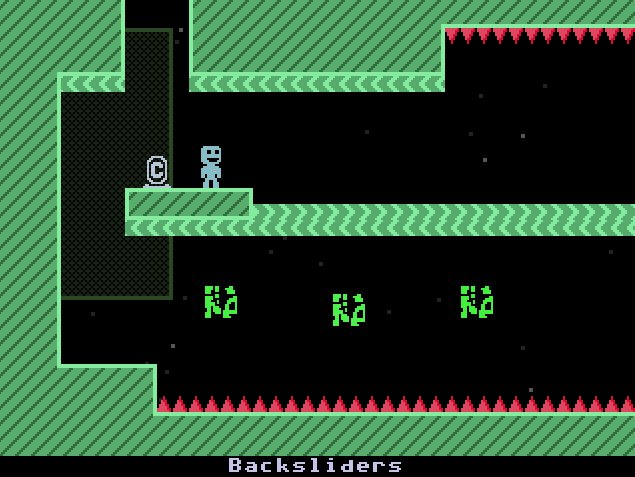
At this point we seem to have come full circle. Captain Viridian made his debut in Terry Cavanagh's oddly-titled VVVVVV, a clear love-letter to games on systems such as the ZX Spectrum. The graphics and sound of VVVVVV are resolutely low-end, there are homages to titles such as Dizzy and Manic Miner, and even the flickering bars of the loading screen will be familiar to anyone who has ever used a Commodore 64.


Captain Viridian himself - herself? - is about as basic as a character can get while still qualifying for the description of "character". A chunky single-colour stick figure with a simple face, the good Captain has only two frames in his walk cycle and the same number of facial expressions. His five friends (all with names beginning with V, hence the game's title) look identical, aside from being different colours. It is unclear as to exactly what Captain Viridian is: the game has a nominal science fiction plot involving spaceships and dimensional warps, so Viridian is presumably an astronaut. But is he wearing a spacesuit? Is he an alien of some kind?


VVVVV's shout-out to the original Dizzy.


Had VVVVVV been a genuine ZX Spectrum release, this question would likely have been answered by airbrushed cover art portraying Captain Viridian as a dashing Buck Rogers-alike. But in 2010 he was presented, simply and purely, as a video game character. Just as early animated characters such as Felix, Bosko and Koko seemed well aware that they were ultimately just blobs of ink, Captian Viridian is designed to be nothing more than a bundle of pixels arranged in a rudimentary humanoid form. VVVVVV turns crude graphics into a kind of pop art, doing for pixels what Roy Lichtenstein did for printing dots.


Captain Viridian faces three enemies modelled around glitched-up ZX Spectrum sprites.


For all its retro-80s stylings, VVVVVV is actually a very clear product of the twenty-first century. The early days of video games witnessed the phenomenon of the bedroom programmer: self-employed designers, some in their teens, who were capable of churning out industry-changing hits. This died out as games became more complex, but in the era of the World Wide Web small games once again became big: first there were online Flash games, then games for mobile devices and games downloaded via online services such as Steam and Xbox Live Arcade. Independent game developers once again found a slice of the market, and the bedroom programmer made a comeback.


2011: Kate Wilson


For the last time in this series, I've had to cheat. Dark Energy's Hydrophobia actually made its debut in September 2010 on the Xbox Live Arcade service, but as all subsequent versions - including Hydrophobia Prophecy, a rejigged release generally regarded as definitive - came out in 2011, it's close enough.


Hydrophobia is set in the near future when, faced with overpopulation, humanity has begun to construct floating cities. One of these cities, the Queen of the World, is targeted by a band of terrorists; a systems engineer named Kate Wilson is caught up in the middle of the chaos, and turns out to be the only one who can save the rapidly-flooding city.


In many ways, the world of Hydrophobia and its characters do not live up to their potential. We are given hints that Kate has a fear of drowning, possibly resulting from a childhood trauma - if she begins to lose oxygen during gameplay, we hear echoes of a child calling and coughing, as though experiencing Kate's memories - but her backstory is never explored. The terrorists have an interesting motive - they turn out to be devotees of Thomas Malthus, a pioneer in the study of population growth - but their leader turns out to be a standard-issue moustache-twirler, complete with Blofeld scar.


On the other hand, the portrayal of Kate Wilson is refreshingly normal. She is not a glamorous fantasy figure in the manner of Lara Croft but instead - in the context of the game's science fiction setting - recognisable as an everyday person; she is a perfectly credible mechanic of the future. Voice actress Lisa Heanley does a good job on her many soundbites, which range from confident remarks on her progress to anguished exclamations in the face of danger.


The different releases of the game contain two different endings, both leaving Kate's fate uncertain. Before Hydrophobia was released two sequels were promised, so the story of Kate Wilson may yet be continued.


2012: The Rogue Pixel


The Dare to be Digital contest, which was designed to promote the work of student game designers, began in 2000. Originally restricted to Scottish entrants, it began allowing international contestants in 2005, and in 2007 the contest began a partnership with BAFTA, which introduced a "Ones to Watch" award open only to Dare to be Digital winners.


One of the three contest winners from 2012 was Pixel Story, made by a five-person team from Manchester called Loan Wolf Games. Like VVVVVV this has its aesthetic roots in an earlier age, but it picks a wider range of influences. In the intro we see that the main character started life as the tennis ball from Pong; after a glitch allows him to break through a barrier into the wider world he develops a face and body. From then on he must explore a range of lands that evoke various classic games from Super Mario to Castlevania, all the while avoiding the computer's efforts to fix its error by erasing him.


The British video games industry has had its ups and downs lately: on the one hand major studios have been forced to close in the face of the recession, on the other the industry has recently been gifted with tax breaks that will help keep it afloat amongst international competition. Endeavours such as Dare to be Digital are vital in nurturing new talent for future generations of games developers.


1 - 2 - 3 - 4 - 5 - 6