Showing posts with label video games. Show all posts

Sunday, 30 September 2012

British Gaming Heroes: 2008-2012

Continuing my series of posts taking a year-by-year look at the history of British video games, focusing on the many colourful characters that the industry cooked up.


2008: Sackboy


Developed by Guildford-based Media Molecule, LittleBigPlanet is one of the most successful video game franchises of recent years. But while it may cutting edge technically speaking, its protagonist is decidedly low-fi.


The star of the LittleBigPlanet series is Sackboy, a tiny brown woolen character who resembles the kind of thing that Jim Henson might have created had his budget unexpectedly run out. Sackboy inhabits a world peppered with similar craft-fair creations and must make his way across levels made from cardboard cutouts, hinged ornaments, toy building blocks and various other household objects.


LittleBigPlanet's aesthetic is cut from the same cloth - if you'll pardon the pun - as the contemporary vogue for creepy-cum-sweet-cum-ironic-cum-nostalgic imagery
that is figureheaded by Tim Burton. As a character Sackboy evokes both the classic stop motion creations of Oliver Postgate, and iconic Japanese knick-knack characters such as Hello Kitty; he is both cute, and slightly unsettling in his demented, childlike behaviour. As Jan Svankmajer has demonstrated, even the most innocent toy can take on an uncomfortable edge when it is animated.


The game's hand-made visual style ties in with its heavy focus on user-generated content. Players can customise Sackboy by altering his clothing and facial features, and also create their own levels. This latter feature can be used online, with players in different parts of the globe collaborating on a single piece of work together. Sackboy, with his decidedly home made vibe, serves as a perfect master of ceremonies for this creative series.


2009: The DJ Heroes


One of the biggest gaming franchises of the twenty-first century is the Guitar Hero series. The first title was created by the American developer RedOctane in 2005 and was followed by five sequels and various spin-offs. For two of those spin-offs - DJ Hero and its sequel - publisher Activision turned to FreeStyleGames, a Warwickshire-based company that was founded mainly by former members of Rare and Codemasters.


Ditching the cast of the Guitar Hero games, DJ Hero introduced us to a new set of characters: masked Mexican wrestler Jugglernort, gator-grappling swampbilly Cleetus Cuts; upstart adolescent DJ Kid Itch; punk rocker Kitty Smash; day-glo diva Candy Nova; stylin', shades-wearing Cool Papa G; mildly disturbing Vundaboy; and scrappy tomboy Mixy Trix. DJ Hero 2 added some more characters to the roster, and both games also gave players the option to control animated versions of real-life DJs.


DK Mixtress who, alongside DJ Kawstic, appeared in the first game but didn't make the cut for DJ Hero 2.


In terms of character design, the entire Guitar Hero franchise owes something of a debt to the Gorillaz videos. The protagonists share a similar gangly morphology that adds a hint of comedy to their effortlessly cool personas, a hint of comedy that is refreshing when it comes to designs so knee-deep in cool. There will be a time - if it hasn't happened already - when with-it youth will look at DJ Hero and find it to be so 2009, but perhaps with fondness rather than derision. As Yellow Submarine demonstrates, some pop music imagery is so of-its-time that it becomes eternal.


An example of Rebecca Thompson's stylish artwork for DJ Hero 2. More can be seen here


2010: Captain Viridian


At this point we seem to have come full circle. Captain Viridian made his debut in Terry Cavanagh's oddly-titled VVVVVV, a clear love-letter to games on systems such as the ZX Spectrum. The graphics and sound of VVVVVV are resolutely low-end, there are homages to titles such as Dizzy and Manic Miner, and even the flickering bars of the loading screen will be familiar to anyone who has ever used a Commodore 64.


Captain Viridian himself - herself? - is about as basic as a character can get while still qualifying for the description of "character". A chunky single-colour stick figure with a simple face, the good Captain has only two frames in his walk cycle and the same number of facial expressions. His five friends (all with names beginning with V, hence the game's title) look identical, aside from being different colours. It is unclear as to exactly what Captain Viridian is: the game has a nominal science fiction plot involving spaceships and dimensional warps, so Viridian is presumably an astronaut. But is he wearing a spacesuit? Is he an alien of some kind?


VVVVV's shout-out to the original Dizzy.


Had VVVVVV been a genuine ZX Spectrum release, this question would likely have been answered by airbrushed cover art portraying Captain Viridian as a dashing Buck Rogers-alike. But in 2010 he was presented, simply and purely, as a video game character. Just as early animated characters such as Felix, Bosko and Koko seemed well aware that they were ultimately just blobs of ink, Captian Viridian is designed to be nothing more than a bundle of pixels arranged in a rudimentary humanoid form. VVVVVV turns crude graphics into a kind of pop art, doing for pixels what Roy Lichtenstein did for printing dots.
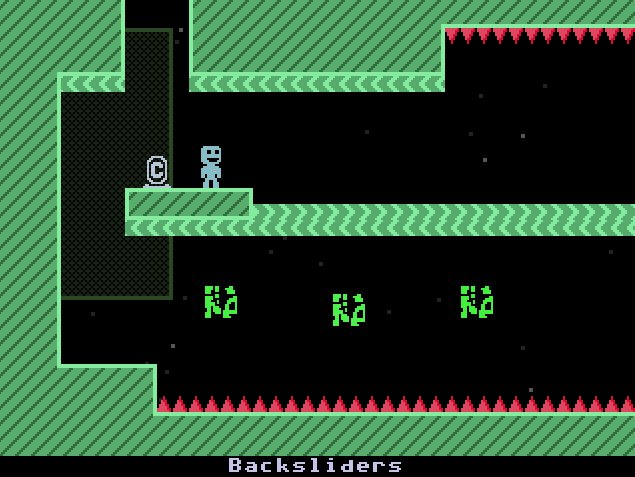


Captain Viridian faces three enemies modelled around glitched-up ZX Spectrum sprites.


For all its retro-80s stylings, VVVVVV is actually a very clear product of the twenty-first century. The early days of video games witnessed the phenomenon of the bedroom programmer: self-employed designers, some in their teens, who were capable of churning out industry-changing hits. This died out as games became more complex, but in the era of the World Wide Web small games once again became big: first there were online Flash games, then games for mobile devices and games downloaded via online services such as Steam and Xbox Live Arcade. Independent game developers once again found a slice of the market, and the bedroom programmer made a comeback.


2011: Kate Wilson


For the last time in this series, I've had to cheat. Dark Energy's Hydrophobia actually made its debut in September 2010 on the Xbox Live Arcade service, but as all subsequent versions - including Hydrophobia Prophecy, a rejigged release generally regarded as definitive - came out in 2011, it's close enough.


Hydrophobia is set in the near future when, faced with overpopulation, humanity has begun to construct floating cities. One of these cities, the Queen of the World, is targeted by a band of terrorists; a systems engineer named Kate Wilson is caught up in the middle of the chaos, and turns out to be the only one who can save the rapidly-flooding city.


In many ways, the world of Hydrophobia and its characters do not live up to their potential. We are given hints that Kate has a fear of drowning, possibly resulting from a childhood trauma - if she begins to lose oxygen during gameplay, we hear echoes of a child calling and coughing, as though experiencing Kate's memories - but her backstory is never explored. The terrorists have an interesting motive - they turn out to be devotees of Thomas Malthus, a pioneer in the study of population growth - but their leader turns out to be a standard-issue moustache-twirler, complete with Blofeld scar.


On the other hand, the portrayal of Kate Wilson is refreshingly normal. She is not a glamorous fantasy figure in the manner of Lara Croft but instead - in the context of the game's science fiction setting - recognisable as an everyday person; she is a perfectly credible mechanic of the future. Voice actress Lisa Heanley does a good job on her many soundbites, which range from confident remarks on her progress to anguished exclamations in the face of danger.


The different releases of the game contain two different endings, both leaving Kate's fate uncertain. Before Hydrophobia was released two sequels were promised, so the story of Kate Wilson may yet be continued.


2012: The Rogue Pixel


The Dare to be Digital contest, which was designed to promote the work of student game designers, began in 2000. Originally restricted to Scottish entrants, it began allowing international contestants in 2005, and in 2007 the contest began a partnership with BAFTA, which introduced a "Ones to Watch" award open only to Dare to be Digital winners.


One of the three contest winners from 2012 was Pixel Story, made by a five-person team from Manchester called Loan Wolf Games. Like VVVVVV this has its aesthetic roots in an earlier age, but it picks a wider range of influences. In the intro we see that the main character started life as the tennis ball from Pong; after a glitch allows him to break through a barrier into the wider world he develops a face and body. From then on he must explore a range of lands that evoke various classic games from Super Mario to Castlevania, all the while avoiding the computer's efforts to fix its error by erasing him.


The British video games industry has had its ups and downs lately: on the one hand major studios have been forced to close in the face of the recession, on the other the industry has recently been gifted with tax breaks that will help keep it afloat amongst international competition. Endeavours such as Dare to be Digital are vital in nurturing new talent for future generations of games developers.


1 - 2 - 3 - 4 - 5 - 6

Saturday, 18 August 2012

British gaming heroes: 2003-2007

Continuing my series of posts taking a year-by-year look at the history of British video games, focusing on the many colourful characters that the industry cooked up.


2003: James Earl Cash


Having initiated a series of games based around car theft and gang warfare, Grand Theft Auto creators Rockstar North decided to turn their attention to another area of the criminal underworld. Manhunt takes its cue from the urban legend of the "snuff film", underground videos of real-life murders.


The main character is James Earl Cash (named, presumably, after Martin Luther King's assassin James Earl Ray), a man sentenced to death for unspecified crimes. At the start of the game Cash awakens to find that he has been mysteriously rescued from death row, only to end up in the clutches of an unseen snuff director named Starkweather (presumably after the teenage serial killer Charles Starkweather). The object of the game is to collect various murder implements - plastic bags, knives and so forth - and provide footage for the director by killing the gang members who inhabit the inner-city playing field.


Manhunt quickly found itself a place in the ranks of controversial games: "I was pretty vocal in telling my superiors that while I'd do whatever they asked me to do (within reason), I didn't support Manhunt's release", said Jeff Williams, an employee at Rockstar at the time the game was published. "It may sound surprising, but there was almost a mutiny at the company over that game... [it] just made us all feel icky. It was all about the violence, and it was realistic violence. We all knew there was no way we could explain away that game. There was no way to rationalize it. We were crossing a line."


Williams draws a contrast between the Grand Theft Auto series - which parodied American crime films and could therefore be taken as a joke - and Manhunt, which went for a far more gritty feel.


Although the impact is somewhat undercut by the fact that the victims of the "snuff films" are clearly just blocky CGI people.


The instruction booklet for Manhunt is presented as a faux snuff video catalogue. It's all done in the best possible taste.


As a character, James Earl Cash is a blank slate. We don't even know why he was sentenced to death, presumably so that we can stay on his side and think of him as a victim rather than a criminal. The director, Starkweather, is a far stronger character: as you play the game Starkweather's voice taunts you when you make a mistake and cheers you when you perform a murder with a series of suitably sleazy catchphrases ("I haven't been this turned on since... well, let's not go into that.") The most memorable character in Manhunt is not its protagonist, but its villain.


2004: The Hero of Oakvale


One of the main draws of role-playing games such as Dungeons and Dragons is that you can create your own character: as he or she exists only in your head and on some scraps of notepaper, your imagination is the limit when it comes to crafting your hero or heroine. Digital RPGs could never compete in this area - you could only create the a character within the boundaries of the code. In the original Final Fantasy, for example, you could choose from a set of character types - fighter, black mage and so forth - and pick a name, and that was it. Later games in the series gave up altogether and presented you with a pre-packaged character, such as Final Fantasy 7's hero Cloud Strife.


One of the more thorough attempts made by a digital RPG to capture the open-ended nature of its pen-and-paper cousins can be found in Peter Molyneux's Fable. The main character, identified simply as the Hero of Oakvale, starts off as a child and grows during the course of the game. The player can choose to make their hero either good or evil - if you go down the evil path, the protagonist even develops glowing red eyes and a pair of horns.


"[Y]ou play through the life of that character", said Peter Molyneux in an interview, back when the game was in development under the name of Project Ego. "By the end of the game, he may be 30 in your case, while in my case he may be 40, in another person's case he may be 50 or 60... You don't have to be the good guy. You can be nasty. If you want to, if you really want to, if you want to walk into a town and think, 'I don't like the way these people are looking at me. I'm gonna kill 'em all.' Absolutely. Fair enough. And the world will change to reflect that."


Fable II, released in 2010, puts the player in control of the Hero of Bowerstone, a character with even more flexibility. Not only can you choose between a male or female hero, you can also alter their body weight by eating certain foods. Fable III, meanwhile, stars a monarch with a whole kingdom at his or her disposal.


There will always be limitations, of course, but the Fable series raises an interesting question: are the best video game characters the ones that we create ourselves?


2005: Mr Pants


"Wait! Wait!" said Rare's website back in the year 2000. "We know that surveys are Evil incarnate, but we've got Mr. Pants the Survey Man to lead you through ours. How can you resist?"


Rare was noted at the time for its offbeat sense of humour, and the decision to use a crudely-drawn man wearing nothing but a bowler hat and some Y-fronts to host the site's survey page is a fairly typical example. But that was just the beginning of Mr Pants' career...


In the same way that Disney animators often hide the silhouette of Mickey Mouse's head into their films, Mr Pants began making discreet cameos in Rare's games - the funfair stage in Banjo-Tooie had a light-up sign in his image, for example. And in 2005, Mr Pants made the leap to starring in his own game.


Granted, it was a bit of a last-minute move. The game started out as Donkey Kong Coconut Crackers, but when Rare lost the rights to use Nintendo's simian hero they retooled it as It's Mr Pants.


 The game is a straightforward puzzler based around sliding blocks about, with Mr Pants only appearing in the background (and even then, not on every level), but he adds an undeniable charm. Mr Pants now has a voice - he turns out to sound rather like Harry Enfield's "only me" character - and throughout the game he yells catchphrases such as "pants away", "any time soon would be nice" and "my brain hurts".


2006: Nick Mason


And here we have another trawl through the seedy, brutally violent underbelly of big city society. But in case you were getting the impression that contemporary video games were obsessed with putting their players in control of remorseless criminals, Urban Chaos: Riot Response instead puts you on the side of the law.


An unnamed city has collapsed into riots and gang violence following a terrorist attack, and it's up to Nick Mason and his cohorts in the anti-crime unit T-Zero to get things back into order.


By its very nature, the genre of the first-person shooter is not a fertile ground for characters. There are exceptions (I covered Rare's Perfect Dark and its spy heroine in the previous post in this series, and the popular Duke Nukem franchise is also worth a mention) but, by and large, the protagonist in such a game will be a pair of limbs, some weapons and little else. Probably the most famous first-person shooter is Doom, whose hero is known by fans simply as the Doomguy - says it all, really.


One of the game's live action newscasts.


Urban Chaos does not buck this trend: the only times we get a clear look at Mason are when still photographs of him (portrayed by a model) are shown during the faux newscasts shown between levels, and the closest thing to dialogue from him is the slow-motion yell you hear when it's game over.


But nonetheless, the game succeeds in giving its hero presence, simply by giving him a reputation. The various medics, firemen and cops that assist you express disbelief that they're working with the Nick Mason, while gangsters taunt "I thought you were supposed to be good, Mason!" Not bad for a pair of hands.


2007: Nariko


Some things are evergreen. In an earlier post in this series I covered Kuros, Rare's loinclothed, sword-wielding Conan-alike from 1987. Twenty years down the line, Cambridge-based developer Ninja Theory gave us the other side of the coin with Heavenly Sword. This game introduces us to Nariko, a flame-haired swordswoman in the tradition of the comic book heroine Red Sonja.


Nariko may not have been that original a character, but Ninja Theory did play with things a little. For one, Nariko makes the unusual career move of dying at the start of the game, which opens in medias res. The remainder of the story leads up to her final moments, in a possible nod to the disjointed chronological structures of Robert E. Howard's sword-and-sorcery tales.


Nariko's birth in the online series.


The game was promoted with a short online animated series from the London-based studio Chase. Set before the events of the game the series deals with the prophesied birth of a saviour who will rid the land of an evil warlord. The people are bitterly disappointed to find that the child is a girl, only to be proved wrong when the adult Nariko shows her valour.


But it doesn't seem to have been her heroic self-sacrifice which earned Nariko her fans amongst gamers: instead, she was hailed as one of "gaming's hottest babes" by MSN and counted amongst UGO's "top animated hotties". Like Lara Croft from eleven years beforehand, Nariko is an example of the double-edged portrayal of women in video games.


Almost there - in the next post, we'll be taken up to the present day with a thoroughly modern batch of heroes.

1 - 2 - 3 - 4 - 5 - 6

Saturday, 30 June 2012

British gaming heroes: 1998-2002

Continuing my series of posts taking a year-by-year look at the history of British video games, focusing on the many colourful characters that the industry cooked up.

Well, I tried to inject some variety into this instalment. While I was researching I hoped to cover a range of different developers, but it soon became apparent that one company dominated this era: Rare. Four of the five games I picked were made by Rare, and the fifth was brought to us by what was essentially a Rare split-off company.

So let us commence this overview of Rare's golden years...


1998: Banjo and Kazooie


 In 1998 Pixar released its second feature, A Bug's Life, and DreamWorks jumped on the CGI bandwagon with Antz. This initiated a cycle of CGI films set in the traditional juvenile milieu of talking animals, but - in theory, if not always in practice - containing an undercurrent of altogether sharper humour that adults would also appreciate. Rare's Banjo-Kazooie arrived just in time for the zeitgeist.


The story of Banjo-Kazooie is nothing special - the hero's sister is kidnapped, so he must rescue her - but what makes its world memorable is the characters. As well as the central figures of Banjo the bear, Kazooie the bird and Guntilda the wicked witch, there is a whole host of side personalities: Mumbo Jumbo, a skull-headed shaman; Dingpot, Gruntilda's disloyal cauldron; Blubber, a pirate hippo who wants a jetski; Loggo, an anthropomorphic toilet. The characterisation is not always original (Banjo himself is basically Goofy with a bit of Eccles, complete with the former's patented "guh-huh") but is always strong.


Kazooie's sarcastic exchange with Loggo the toilet.


 Banjo-Kazooie contained a lot of dialogue but, due to the technological limitations of the period, none of it was actually voiced. Instead, Rare came up with an ingenious solution: each character is given three short samples which are played in random succession as their dialogue text appears onscreen. When Banjo talks, we hear "guh-guuh-gur-guuh-gur-gur-guh-guuh-guh", while Gruntilda lets out strings of shrill croaks and Blubber talks in a series of belches. It's both funny, and effective.


The game has a wry sense of humour, with even the bodily-function gags just coy enough to work. The opening sequence kicks off with a parody of Snow White, as Gruntilda asks her cauldron "Dingpot, Dingpot, by the bench, who's the nicest looking wench?"; these gags carry on until the final confrontation with the hag, during which she repeatedly remarks that she needs to use the toilet once the fight's over.


This was stepped up considerably in the sequel, Banjo-Tooie. At one point the heroes fight a giant inflatable dinosaur whose air-nozzle is positioned... between his legs. Oo-err.


1999: Jet Force Gemini


 If Banjo-Kazooie pointed forward to the new wave of CGI features, Jet Force Gemini took the opposite approach and harked back to previous decades. With a noticeable retro-eighties flavour and the acknowledged influence of the anime series Battle of the Planets, it was informed by irony-tinged nostalgia: a game for the generation of twentysomethings who still wore Transformers t-shirts.


Jet Force Gemini pitted a quartet of spacefaring heroes - Juno, Vela, Lupus the dog and Floyd the Droid - against the evil Mizar and his hordes of aliens; along the way they were also tasked with rescuing good aliens, who resembled Ewoks. The cuddly demeanour of the characters was set off by the level of violence involved, with green goop spurting from insectoid villains, but as with the cult British science fiction comic 2000 AD this kind of thing was conducted in a healthily tongue-in-cheek manner. When the player happens upon a cache of flares a message window helpfully explains that this is a type of ammunition, not a sixties fashion accessory.


The first promotional art of Juno and Vela was rather disturbing, depicting them as creepy doll children that call to mind Svankmajer's Alice rather than any Saturday morning children's anime. Whether this look is merely a botched attempt to adapt a traditional manga style to 3D or a result of Rare's warped sense of humour is unclear.


By the time the game had been released the characters had been reconfigured as adults, partly due to comments from Nintendo's Shigeru Miyamoto, partly due to the progress in the skills of the game's graphical team, and - according to some reports - partly due to concerns about portrayals of children with guns: the Columbine shooting occurred during the game's development.


Jet Force Gemini was well-reviewed but not a commercial success, possibly because something was still a little off about its general tone. A 2D adaptation for the Game Boy was in development but ultimately cancelled, and a sequel was never made. Nevertheless, the title has its staunch fans to this day.


2000: Joanna Dark


 One of Rare's biggest successes was GoldenEye 007, a 1997 game based on the James Bond film from two years beforehand. There was demand for a sequel, but the development team decided against another Bond project, instead creating a special agent of their own.


Perfect Dark is set in the near future and avoids the Cold War thriller inspirations of GoldenEye in favour of a science fiction yarn, drawing on contemporary UFO folklore. A war is on between bug-eyed greys on the one side and reptilians disguised as humans on the other, with an espionage group working for Daniel Carrington (a relative of The Thing from Another World's Dr. Carrington, perhaps?) caught in the middle. The player must guide one of Carrington's spies, Joanna Dark, through all of this intrigue until the final confrontation on an alien planet.


Very much a product of the post-Lara Croft wave of gaming heroines, Joanna Dark was also influenced by the female leads of The X-Files, Nikita and Ghost in the Shell. She may not have become a household name in the same way as Lara, but her game was well received.


A particularly eager reaction came from N64 Magazine, which ran specially-made artwork of Ms. Dark by its house illustrator Wil Overton, who had made a name for himself in the early nineties with his anime-inspired magazine covers. This mangafied Joanna seems to have caught the eye of Rare, as Overton was recruited to redesign the character for the prequel Perfect Dark Zero.


Publicity art was released revealing Overton's portrayal of a younger and very cartoonish Joanna Dark, but this look was ultimately rejected. Instead, Zero ran with another quasi-realistic version of the heroine, albeit one retaining the funky new hairdo that Overton gave her.


Perfect Dark Zero was released in 2005, and in the same year the series went multimedia with the publication of Greg Rucka's novel Perfect Dark: Initial Vector. After this came Cold FuZion Studios' six-issue comic Perfect Dark: Janus' Tears, and a second novel by Rucka. Perfect Dark Core, planned as the next game in the series, began development but was aborted.


Concept art for the abandoned Perfect Dark Core.


2001: Conker


Banjo-Kazooie was announced alongside another project, a game called Conker's Quest which starred a Disneyesque squirrel. The two titles looked very similar, the main distinction being that Conker's Quest seemed rather more sugary and innocuous, lacking even Banjo's occasionally offbeat sense of humour.


When Banjo-Kazooie came out, its sister title was still under wraps. In 1999 Conker's Pocket Tales came out on the Game Boy, and seemed strangely isolated - it was clearly designed as a tie-in to a higher-profile release, but yet Conker's Quest (or Twelve Tales: Conker 64 as it was known by then) was still nowhere to be seen.


When the game eventually arrived on the scene it had been renamed Conker's Bad Fur Day and had undergone a major retooling. Now rated 15+, it starred a foul-mouthed, booze-swilling, cigar-chomping Conker who spent the game gunning down Nazi teddy bears, urinating on firey devils and killing a vampire by feeding him peasants until he became so fat that he fell into his own deathtrap. Banjo unbound, this was a platform game for the South Park generation.


Alongside this toilet-wall comedy was a visual style which resembled a cross between Pixar or DreamWorks CGI and The Trap Door, with perhaps a bit of Rex the Runt thrown in. Unlike Banjo-Kazooie, Bad Fur Day managed to squeeze in fully-voiced dialogue, adding the radio comedy element of Monkey Island or Simon the Sorcerer.


Conker's Etiquette Guide, an online Flash cartoon released to promote the game.


The game was well received, primarily for its humour, but was not a great seller. A sequel was on the cards (reportedly, this is why Rare dropped the game's original ending, which was to have had Conker committing suicide) but never appeared. Although Bad Fur Day was remade for the Xbox as Conker: Live and Reloaded, the Conker series was a bit of a flash in the pan; still, the character made his mark, and still has his fans.


Bad Fur Day was the last game Rare created for the Nintendo 64; the company was bought by Microsoft the following year. Something of an end of an era for Rare, which has recently been restructured by Microsoft after some of its Xbox releases were met with disappointing sales.


2002: Sergeant Cortez


Cortez (centre), with two co-stars.


By the time Perfect Dark was released several members of its development team had left to form Free Radical Design, now known as Crytek UK. The company's first release was a 2000 number called TimeSplitters, which attempted to meld the gritty sci-fi stylings of games such as Perfect Dark with a sillier, more cartoonish approach. Unfortunately, the effect was hampered by the clumsy CGI that games of this period were mired in - it's an irony that, in terms of graphics, late-period 2D games such as Yoshi's Island or Earthworm Jim have aged much better than the first several years' worth of 3D games.


The sequel did not entirely avoid this problem, but it went some way to compensating. The game was released alongside a wave of publicity art that translated the blocky CGI characters into vibrant 2D drawings reminiscent of Jamie Hewlett's work on Tank Girl and Gorillaz. Gleefully kitsch, the designs are a loving send-up of the comic book aesthetic that rival games were taking dead seriously.


The title characters of the TimeSplitters series are actually the antagonists - a race of time-travelling aliens. The original game didn't have a single hero, with the player instead controlling a different character for each time period, which ranged from an Egyptian tomb in 1935 to a rocket base in 2035. TimeSplitters 2 introduced a series protagonist in Sergeant Cortez while still keeping the first game's dynamic of a different character for each era: like the fellow in Quantum Leap, Cortez travels through time by possessing the bodies of various people who lived over the ages.


Disappointingly, the third game - TimeSplitters: Future Perfect - dropped this style in its publicity art, although it retained a similar sense of humour. A fourth game was announced, but its development has been troubled and it has yet to surface.


And that's it for another month. Next time: fantasy heroics, gritty crime, and a chap in his Y-fronts.

1 - 2 - 3 - 4 - 5 - 6