The second in a series of posts using Denis Gifford's book British Animated Films, 1895-1985: A Filmography to provide a decade-by-decade analysis of British animation's history.
Disclaimer: Although wide-ranging Gifford's book is not
perfect. He missed out several films and sometimes provided incorrect
dates or crew information. I have done my best to correct any errors
which I have found myself repeating in these posts.
The second in a series of posts using Denis Gifford's book British Animated Films, 1895-1985: A Filmography to provide a decade-by-decade analysis of British animation's history.
Disclaimer: Although wide-ranging Gifford's book is not
perfect. He missed out several films and sometimes provided incorrect
dates or crew information. I have done my best to correct any errors
which I have found myself repeating in these posts.
By the end of the last decade there were three directors working in British animation: stop-motion animator Arthur Melbourne Cooper,
trickfilm director Walter R. Booth and silhouette
animation pioneer Charles Armstrong. The 1910 films listed by Gifford are Armstrong's
The Clown and his Donkey, Booth's
The Toymaker's Dream, and a film from a newcomer - Cecil M.
Hepworth's Embroidery Extraordinary, a
trickfilm featuring an animated needle and cotton.
More new directors began cropping up in 1911. Stuart Kinder made
A Merry Christmas to All Our Friends ("Animated letters from the title phrase as a greeting from the cinema manager to his patrons"), while J.H. Martin directed a complex-sounding film entitled
The Little Artists. Gifford quotes a contemporary synopsis from
Bioscope:
Two children are shown, one holding a teddy bear, while the other girl sketches on a blackboard, and then the latter is replaced by a frame of canvas to which a thread is attached, which by its own volition forms a star, and in closer view is then seen to take various other shapes - a child's photograph, a lighthouse, Humpty Dumpty before his fall, the Man in the Moon, a picture of a rabbit, and portraits of King George V and his consort, the thread finally tracing the legend 'Au Revoir' with which the film concludes.
The year also saw the release of Booth's
Animated Putty, Cooper's
Road Hogs in Toyland, and three films by Armstrong (the cinema message
Ta-Ta! Come Again, the political satire
Mr. Asquith and the Clown, and an advert entitled
The Best Cigarette is a Jones).
British animation steadily increased in production early in this decade: Gifford lists three films for 1910, seven for 1911, and thirteen for 1912. In 1912 Booth and Cooper were still active, and there was a new director in F. Martin Thornton. He directed two films that year,
In Gollywog Land and
Santa Claus (the latter co-directed by R.H.
Callum); Gifford identifies
In Golliwog Land as the
first animated film in colour. The synopses are intriguing:
The gollywog manages to dodge the apples but when the sough covers the basin, six little wogs break through. Then the gollywog gives a conjuring act with flowers, and later goes for a ride in his auto-boot, runs into a rival motorist, and has to amputate his leg. First aid with a vengeance! (taken from Bioscope)
live action/animated toy sequences. Elsie goes to sleep on Christmas Eve and dreams that Father Christmas arrives down the chimney and transforms her into a Tingaling, a fairy. They travel by reindeer sledge to his home at the North Pole where busy little gnomes are making toys for the children, and Santa enlists the aid of Father Neptune to help a sea captain return to his family. (Gifford's own synopsis)
Both films contain animation by Walter R. Booth and Edgar Rogers. 1912 also saw the release of
Sports in Moggyland, a stop-motion film whose director is not known. "[I]t is quite impossible after seeing them to believe that these puppets are not endowed with an intelligence which enables them to fully appreciate and enjoy the antics they engage in," reads the
Bioscope review. 1913 saw Thornton's assistant Edgar Rogers direct a film himself (
The Nightmare of the Gladeye Twins; like
Santa Claus it takes place in the dreams of a girl named Elsie, and may be a sequel to that film) but is chiefly notable for the first six films in Max J. Martin's
Pathé Cartoons series. This is the first British animated series - unless, of course, you want to make a case for the Elsie films constituting a series...
 Harry Furniss in 1912.
And so we come to 1914. Gifford, in the introduction to his book, says that British animation had a boost during World War I thanks to a demand for propaganda cartoons. The first such film listed in the book is
Peace and War Pencillings by Harry
Furniss, a throwback to the days of filmed lightning cartoonists; the film portrays cartoonist
Furniss drawing a peaceful London scene which is disrupted when the dome of the National Gallery turns into the face of Kaiser Wilhelm.
 Still from Lancelot Speed's
 Bully Boy No. 1
, which combines live-action lightning cartooning with animation.
After this came
War Cartoons by Dudley Tempest; something called
Cine War Cartoons No. 1, of which little is known beyond the fact that it was released by R.
Prieur; a second
Furniss offering, titled simply
War Cartoons;
War Cartoons by Sidney Aldridge;
The Voice of the Empire ("The longest cartoon to date, a full 1,000 foot reel running some 15 minutes" says Gifford; no director is credited); F.
Baragwanath's The Kaiser's Nightmare; the first four entries in Lancelot Speed's
Bully Boy series (
Bully Boy No. 1,
French's Contemptible Little Army,
Sleepless and
Sea Dreams); the five-part
Wireless from the War Series, whose director is not named; Charles Urban's
The Kineto War Map Series, which would last for 15 films, ending in 1916; Dudley Tempest's
British War Sketches,
Christmas War Sketches and
Merry War Jottings;
War Skits by Sidney Aldridge; Dudley
Buxton's Proverbs and War Topics (AKA
War Cartoons Series 1),
War Cartoon Series 2 and
War Cartoons Series 3; and finally
Studdy's War Studies No. 1, from
future Bonzo creator
George E.
Studdy. It is not entirely clear from the book's synopses how many of these contain true animation and how many are, like the earliest films listed in the book, simply live action films of
cartoonists drawing still images.
Not all of the 1914 films were propaganda. Amongst the other offerings of the year were
Isn't it Wonderful? (Charles Armstrong's return to animation after an apparent two-year break); films by new directors F.
Gandolphi and Louis Nikola; more work from Stuart Kinder and Cecil M. Hepworth; more
films from R.
Prieur that lack directorial credits;
Transformation, which Gifford uncertainly attributes to F. Percy Smith; and the remaining thirty-one films in the
Pathé Cartoons series.
The remaining years of the war would see the continuation of
Studdy's War Studies and Lancelot Speed's
Bully Boy series, which were joined by other topical series: Anson Dyer and Dudley
Buxton's John Bull's Animated Sketchbook;
Topical Sketch, from the
pseudonymous "Say";
Dicky Dee's Cartoons, by Anson Dyer again;
Alick Ritchie's Frightful Sketches;
Britainnia's Budget, brought to us by Ernest H. Mills of Kine
Komedy Kartoons;
Raemakers' Cartoons, Jack
Dodsworth's films based on Louis
Raemakers' illustrations; and Leslie Holland's
John Bull Cartoons.
Other films from this period include non-series work from Speed,
Buxton, Mills and others; Bruce
Bairnsfather's autobiographical
Bairnsfather Cartoons; Leonard Summers'
Humours of... series (
Humours of a Library,
Humours of Football and
Humours of Advertising); several propaganda films by E.P.
Kinsella and Horace Morgan;
The Golfing Cat and
The Hunter and the Dog, two films by George Pearson made in collaboration with cat-loving illustrator Louis Wain; and some early work by Sidney Aldridge and Victor Hicks.
 Slim and Pim.
By this time the American industry had began to create animated series with recurring stars, such as Colonel
Heeza Liar and Mutt & Jeff. Towards the end of the war the UK had joined in with a similarly character-based series: Leslie Dawson's
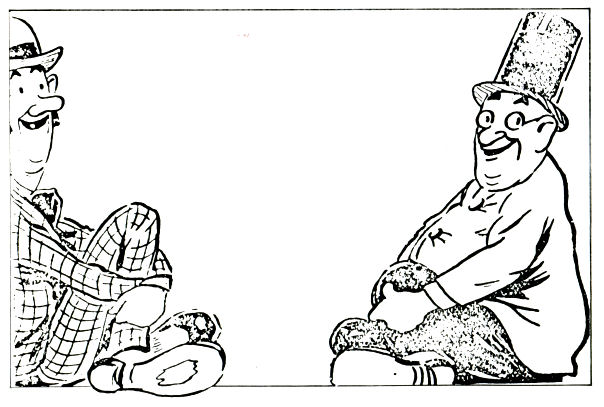
Adventures of Slim and Pim, starring two heroes whom Gifford describes as "England's somewhat feeble answer to Mutt and Jeff". In addition, newspaper cartoonist Tom Webster (who had made his animation debut with 1917's
The History of a German Recruit) directed two 1918 cartoons starring an animated Charlie Chaplin.
 Spick and Span with their creator Victor Hicks
Series films of one variety or another were the order of the day in the final year of the decade: 1919 gave us Dudley
Buxton's three-part
Cheerio Chums series (about the exploits of ex-servicemen finding work after the war); three
Uncle Remus cartoons, directed by Anson Dyer; three
Zig-Zags at the Zoo shorts, directed by Ernest H. Mills and based on J.A. Shepherd's illustrations; the three-part
Poy Cartoon series, based on the work of caricaturist Percy "
Poy"
Fearon; and
A Geni and a Genius by Victor Hicks, a two-part adventure starring Charlie Chaplin. All of these came from the prolific Kine
Komedy Kartoons.
Hicks also made a short called
Spick and Span, with two characters who apparently never appeared in any later shorts (Gifford confuses this with
A Geni and a Genius in his book) and something called
Twice Nightly, which I'm afraid I know nothing about.
 The heroes of the
 Cheerio Chums
series.
Two other companies released animated films that year. Lancelot Speed's Speed Cartoons returned to propaganda, apparently for the last time, with
Britain's Honour.
Bioscope describes the film:
In addition to the heroes who have fought, worked and died in the cause of humanity, we are shown the victims of child labour, bad housing, disease, and other evils, the dragon that preys on humanity and that can only be vanquished by justice, truth, and right, aided by science rightly applied.
 Oh'Phelia.
The third company is
Hepworth Picture Plays, which released four Shakespeare parodies by Anson Dyer:
The Merchant of Venice,
Romeo and Juliet,
'Amlet and
Oh'Phelia. Dyer is the only animator who began work in this decade to have a
biography on
Screenonline (his
Oh'Phelia is
covered as well, as is his 1920 film
Othello) and will, it seems, be remembered as the key figure of this decade.
 A caricature of Anson Dyer, probably a self-portrait. The characters in the top right are, I'm assuming, from his
 Uncle Remus
series.
The 1910s saw animation across the world rise in status from a novel offshoot of
filmmaking to an industry. Looking at British output we can see a leap from the three films of 1910 to the multiple animated series being distributed in 1919.
In 1919 the American industry created Felix the Cat, almost certainly the earliest cartoon star to still be a part of popular culture; the next decade saw the debut of Mickey Mouse. How did British animators react to the changes around them? That will be the subject of the next post in this series.
Other posts in this series: