Hedges, queuing, bowler hats, marmite, miniskirts, Doctor Who, Monty Python, brass bands and Damien Hirst's shark - all of these are national icons, according to Icons: A Portrait of England. I was a bit disappointed that no animated icons made the cut, although the section on Monty Python discusses Terry Gilliam's contributions, while several other icons - such as Winnie the Pooh and Alice in Wonderland - have been adapted into cartoons.
The icons are nominated and then voted for by the site's readers before appearing the front-page list, and the nominees
that have yet to get voted in (old ladies with tartan shopping trolleys and the misused possessive apostrophe are two of my favourites) include a few cartoon-related picks. The only bona fide pieces of animation are Wallace and Gromit, Danger Mouse and Oliver Postgate's children's programmes, but also worth mentioning are the nominations for The Wombles, the Noddy books, Dennis the Menace (surely a bit of a rogue entry, being Scottish and all, but there we go), Sooty, Rupert Bear, Fred Basset, Viz, Paddington Bear, Mr. Bean, the Tufty Club and Eeyore, all of which were animated at one point or another.
Comics are also represented, with Dan Dare, The Eagle, Andy Capp and Roy of the Rovers all present and correct, while puppets turn up quite a bit too: Thunderbirds, Thomas the Tank Engine, Spitting Image, Basil Brush and Zippy from Rainbow have all been nominated and Punch and Judy have been voted into the list of icons. There's also a nomination for the Yellow Submarine but, somewhat oddly, it's the sculpture at the John Lennon Airport rather than either the film or the song.
So take a look through the website, vote for your personal choices, and savour the political ravings of disgruntled people. "You have to be joking", reads a comment posted on the page for kebab vans. "What a travesty of an icon! What a parcel of trendy-leftist pap!" Er, yes, thank you, J. Oswin.
Saturday, 20 March 2010

Sunday, 14 March 2010
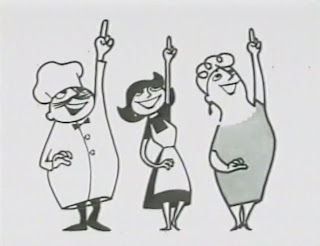
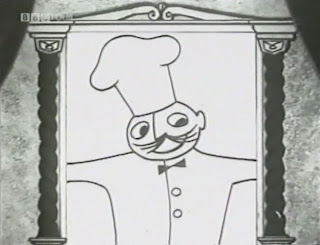
More black and white television commercials: Rael-Brook shirts, McDougall's flour and Castrol petrol
A few more old ads that were shown on BBC4's Animation Nation documentary series. As before, I have no information on who made them.
 First up is an ad for Rael-Brook shirts mainly drawn but with a bit of photoanimation thrown in. The official Rael Brook (the hyphen seems to have been dropped somewhere down the line) website has a bit of background info on the campaign.


 Next is McDougall's flour.




 And finally, here's an ad for Castrol petrol; the driver tries to buy other brands, only to have his car throw a bit of a huff. Interesting bit of character design - anthropomorphic cartoon cars generally have their eyes located on their headlights, while Pixar broke from tradition by using the windscreens; this ad, meanwhile, is the only piece of animation I know of that uses the steering wheel as an eye.


 First up is an ad for Rael-Brook shirts mainly drawn but with a bit of photoanimation thrown in. The official Rael Brook (the hyphen seems to have been dropped somewhere down the line) website has a bit of background info on the campaign.


 Next is McDougall's flour.


 And finally, here's an ad for Castrol petrol; the driver tries to buy other brands, only to have his car throw a bit of a huff. Interesting bit of character design - anthropomorphic cartoon cars generally have their eyes located on their headlights, while Pixar broke from tradition by using the windscreens; this ad, meanwhile, is the only piece of animation I know of that uses the steering wheel as an eye.


Thursday, 11 March 2010
General Nitt and thoughts on British comic adaptations
The launch of the comic Wham in 1964 was promoted with an animated commercial based on Leo Baxendale's strip General Nitt and his Barmy Army. Baxendale describes his reaction to the ad in his autobiography, A Very Funny Business:
In fact, comics as a whole have largely been overlooked by British animation. Countries such as America and Japan have rarely let a major comic property go unadapted in animation, but the only period in which UK animation studios made a point out of using comics as source material was in the era of theatrical shorts, when strips such as Come on, Steve! and Pip, Squeak and Wilfred made the transition to the silver screen. None are exactly household names today, although Denis Gifford has argued that adaptations of familiar strips were the main draw to British animation at a period when American cartoons offered more sophistication.
Since that time it's been slim pickings. The old dean of British comics, The Beano, has produced a tiny handful of animated cartoons: the two aforementioned Beano specials and two versions of Dennis the Menace and Gnasher. That's about all, by my reckoning - unless we start digging up TV ads again. Nutty spawned a Bananaman series that lasted long enough to see its source migrate to The Dandy, while Eagle gave rise to three animated incarnations of Captain Pugwash, making the good Captain arguably the comic strip star who made the most lasting impact on British animation (There was a recent CGI Dan Dare series, too, but it was made in America). As far as I know, that's about it as far as children's comic periodicals go.
On to postwar newspaper strips. The Perishers and Fred Basset have been animated, and Rupert the Bear rivals Captain Pugwash in terms of TV longevity, appearing in the one-off special Rupert and the Frog Song, a Canada-France-UK co-produced cel series, and a recent stop-motion outing. In the world of direct-to-video we have the Viz specials directed by Tony Barnes and Tony Luke's Dominator: The Movie. There are also, of course, the animated adaptations of Raymond Briggs' work - The Snowman, Father Christmas, When the Wind Blows and The Bear - although Briggs' books are generally marketed as picture books as opposed to comics. If we extend our definition of "comic" to cover single-panel cartoons, then there's Halas & Batchelor's Tales from Hoffnung (based on Gerard Hoffnung's cartoons) and Marjut Rimminen's I'm Not a Feminist, But... (based on the book by Christine Roche).
I might be missing a few titles, but that's all I can think of. It may seem a lengthy enough list at first, but when you consider how many animated incarnations of Superman, Spider-Man, Popeye, Peanuts, Asterix, Dragonball, Astro Boy and Sailor Moon have appeared over the years, it's clear that a vast amount of potential source material has gone untapped by the British animation industry. How is it that much-loved characters such as Desperate Dan, Korky the Cat, Judge Dredd and the Four Marys have gone without cartoon shows?
One possible reason is that the animation industry was focusing on another source: children's books. Dan and Korky may not have made the cut, but Paddington, the Wombles and Noddy all made successful transitions. If we were to look at animated TV series from America over the years I think we'd find a lot of comic adaptations, but very few book adaptations. I also get the impression that comics simply weren't seen as respectable subject matter by broadcasters until around the eighties - it's worth noting that two of the most successful comic-to-animation transitions that I noted, Rupert and Captain Pugwash, originated in The Daily Express and the more middle-class comic Eagle respectively.
With the UK's comic industry on even shakier footing than its animation industry, it may seem as though the ship has sailed as far as animated adaptations of British comics go. But not so - in 2009 it was announced that a potential series based on 2000 AD was being planned. Indeed, it's a good time for niche comic properties making the leap to animation, with several American companies contributing to a cycle of direct-to-DVD comic adaptations that range from Superman: Doomsday to Turok: Son of Stone (and they've already tapped into UK talent with Watchmen: Tales of the Black Freighter, based on Alan Moore and Dave Gibbons' masterwork). I wouldn't rule out a few surprises in the future.
Just one last thing to mention: I've done my best to list official adaptations of British comics, but there's also at least one unofficial adaptation that's hit the airwaves. Bash Street Kids Believe in Santa is an hour-long 2002 Christmas special from America that borrows its name from the Beano strip (it even has a character named Smiffy!), apparently without permission. IMDB lists it as "Rapsittie Street Kids: Believe in Santa" and gives the character's name as Smithy, suggesting that legal issues did indeed raise their heads. Hmm.

In the opening number I drew the Barmy Army and an enemy army charging at each other. One day everyone trooped along to a projection studio in Soho to watch a preview of the animated TV advert which had been prepared for the launching of Wham. All the Oldhams top brass were there. The animation studio people had decided to use the Barmy Army. We sat down and waited. The projector started up and the army thundered across the screen in massed ranks. It was an impressive piece of animation. I glanced at Alf [Wallace] and he glanced back at me. They had used the wrong army. We never let on.It's a minor bit of history, but worth a mention as the commercial in question stands as one of surprisingly few animated adaptations of Leo Baxendale's work in comics; the only others I know of are found in the direct-to-video specials The Beano Video and The Beano Videostars, which contain segments based on Minnie the Minx, The Bash Street Kids and The Three Bears.
In fact, comics as a whole have largely been overlooked by British animation. Countries such as America and Japan have rarely let a major comic property go unadapted in animation, but the only period in which UK animation studios made a point out of using comics as source material was in the era of theatrical shorts, when strips such as Come on, Steve! and Pip, Squeak and Wilfred made the transition to the silver screen. None are exactly household names today, although Denis Gifford has argued that adaptations of familiar strips were the main draw to British animation at a period when American cartoons offered more sophistication.
Since that time it's been slim pickings. The old dean of British comics, The Beano, has produced a tiny handful of animated cartoons: the two aforementioned Beano specials and two versions of Dennis the Menace and Gnasher. That's about all, by my reckoning - unless we start digging up TV ads again. Nutty spawned a Bananaman series that lasted long enough to see its source migrate to The Dandy, while Eagle gave rise to three animated incarnations of Captain Pugwash, making the good Captain arguably the comic strip star who made the most lasting impact on British animation (There was a recent CGI Dan Dare series, too, but it was made in America). As far as I know, that's about it as far as children's comic periodicals go.
On to postwar newspaper strips. The Perishers and Fred Basset have been animated, and Rupert the Bear rivals Captain Pugwash in terms of TV longevity, appearing in the one-off special Rupert and the Frog Song, a Canada-France-UK co-produced cel series, and a recent stop-motion outing. In the world of direct-to-video we have the Viz specials directed by Tony Barnes and Tony Luke's Dominator: The Movie. There are also, of course, the animated adaptations of Raymond Briggs' work - The Snowman, Father Christmas, When the Wind Blows and The Bear - although Briggs' books are generally marketed as picture books as opposed to comics. If we extend our definition of "comic" to cover single-panel cartoons, then there's Halas & Batchelor's Tales from Hoffnung (based on Gerard Hoffnung's cartoons) and Marjut Rimminen's I'm Not a Feminist, But... (based on the book by Christine Roche).
I might be missing a few titles, but that's all I can think of. It may seem a lengthy enough list at first, but when you consider how many animated incarnations of Superman, Spider-Man, Popeye, Peanuts, Asterix, Dragonball, Astro Boy and Sailor Moon have appeared over the years, it's clear that a vast amount of potential source material has gone untapped by the British animation industry. How is it that much-loved characters such as Desperate Dan, Korky the Cat, Judge Dredd and the Four Marys have gone without cartoon shows?
One possible reason is that the animation industry was focusing on another source: children's books. Dan and Korky may not have made the cut, but Paddington, the Wombles and Noddy all made successful transitions. If we were to look at animated TV series from America over the years I think we'd find a lot of comic adaptations, but very few book adaptations. I also get the impression that comics simply weren't seen as respectable subject matter by broadcasters until around the eighties - it's worth noting that two of the most successful comic-to-animation transitions that I noted, Rupert and Captain Pugwash, originated in The Daily Express and the more middle-class comic Eagle respectively.
With the UK's comic industry on even shakier footing than its animation industry, it may seem as though the ship has sailed as far as animated adaptations of British comics go. But not so - in 2009 it was announced that a potential series based on 2000 AD was being planned. Indeed, it's a good time for niche comic properties making the leap to animation, with several American companies contributing to a cycle of direct-to-DVD comic adaptations that range from Superman: Doomsday to Turok: Son of Stone (and they've already tapped into UK talent with Watchmen: Tales of the Black Freighter, based on Alan Moore and Dave Gibbons' masterwork). I wouldn't rule out a few surprises in the future.
Just one last thing to mention: I've done my best to list official adaptations of British comics, but there's also at least one unofficial adaptation that's hit the airwaves. Bash Street Kids Believe in Santa is an hour-long 2002 Christmas special from America that borrows its name from the Beano strip (it even has a character named Smiffy!), apparently without permission. IMDB lists it as "Rapsittie Street Kids: Believe in Santa" and gives the character's name as Smithy, suggesting that legal issues did indeed raise their heads. Hmm.

Friday, 5 March 2010
When in the Country
When in the Country is a beautifully designed five-minute public information film from 1963 outlining the Country Code. It was amde by Guild Animation.

 "The ways of the farmer have changed greatly over the years, and so have his pieces... of machinery."


 "But he still works from dawn till dusk, and requires a good night's sleep."


 "Noise at night travels far.; it also travels quite a way during the day."


 Advice and warnings are given in regards to using country roads.


 "Remember too that loudly played radios are annoying both to the farmer and to other visitors to the countryside."

 "Most dogs enjoy a day in the country, but their exuberance is not always appreciated by the locals."


 "Calves and lambs are often born dead, because their mothers have been frightened by dogs."
 "Now, this farm dog is trained not to chase the animals, so train your dog to obey you."
 "People who let their dogs go berserk in the country are often not much better themselves. They have no respect for the farmer's property, his gates, and walls."


 "So please, leave the farmer's things alone."

 "Protect also the wildlife of the countryside, and don't follow the example of the fox."


 "Things that start off in an innocent way can cause a lot of harm."


 "If it is necessary for you to light a fire to cook, make sure you keep it under proper control."


 "On a fine Summer's day, besides the smoke from your fire, other strange things take to the air."

 "Litter: a good job tins can't fly - but they do, and so do some bottles."

 "Rivers and streams are good landmarks from up here, and you'd be surprised at some of the things you see..."
 The film ends with warnings about the dangers posed by litter to animals and farm machinery.

 "The countryside is not provided with litterbins, so follow the country code and take your litter home."


 "The ways of the farmer have changed greatly over the years, and so have his pieces... of machinery."

 "But he still works from dawn till dusk, and requires a good night's sleep."

 "Noise at night travels far.; it also travels quite a way during the day."

 Advice and warnings are given in regards to using country roads.


 "Remember too that loudly played radios are annoying both to the farmer and to other visitors to the countryside."
 "Most dogs enjoy a day in the country, but their exuberance is not always appreciated by the locals."


 "Calves and lambs are often born dead, because their mothers have been frightened by dogs."
 "Now, this farm dog is trained not to chase the animals, so train your dog to obey you."
 "People who let their dogs go berserk in the country are often not much better themselves. They have no respect for the farmer's property, his gates, and walls."

 "So please, leave the farmer's things alone."
 "Protect also the wildlife of the countryside, and don't follow the example of the fox."

 "Things that start off in an innocent way can cause a lot of harm."

 "If it is necessary for you to light a fire to cook, make sure you keep it under proper control."


 "On a fine Summer's day, besides the smoke from your fire, other strange things take to the air."
 "Litter: a good job tins can't fly - but they do, and so do some bottles."
 "Rivers and streams are good landmarks from up here, and you'd be surprised at some of the things you see..."
 The film ends with warnings about the dangers posed by litter to animals and farm machinery.
 "The countryside is not provided with litterbins, so follow the country code and take your litter home."
Subscribe to:
Posts (Atom)